Showing posts with label Probability. Show all posts

Wednesday, November 01, 2006

Michelle's Scribe Post

ScribeBadge11

I am the class scribe for the day. Today in class we started a new unit on perfect squares and square roots.

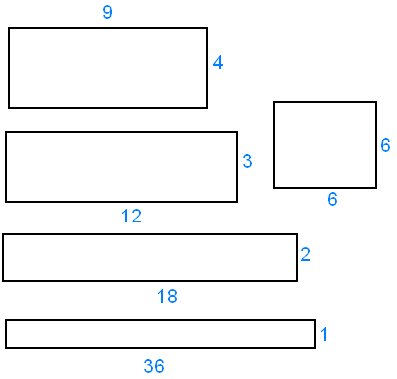
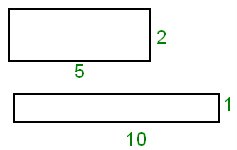
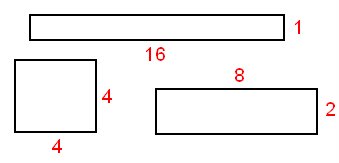
The first thing we had to do was draw as many rectangles as we could with the areas of 10, 16 and 36 on graph paper. To get the areas, you have to multiply the width by the height.
Here are all the possible rectangles that can be made with these areas:
10:

16:

36:

The second thing we did was copy down definitions for factors and perfect squares.

Factors:
-any two or more numbers that are multiplied to make a product

Examples:
18:
1*18
2*9
3*6

25:
5*5

9:
3*3

The 25 and 9 have one thing in common with the factors. Their factors are
multiplied by themselves. example 16: 4*4

Perfect Squares:
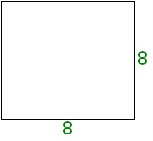
-a square that has the same whole number for all sides

Example:


The last thing we did was make charts on factors, exponents and areas from 1*1 to 30*30. The 2 on the exponents means squared or the number is multiplied by itself one time.

example:


Here are the charts:

Homework:

Answer the following question:
Which one of these numbers are a perfect square?
6, 8, 9 or 10. Justify your answers.
Prove using pictures, words and numbers.
Explain why or why not the number is a perfect square.

Answer: The number that is a perfect square is 9. This is because the only factors of 9 are 3*3.

Here are links to help you:

http://www.mathsisfun.com/square-root.html

http://www.math.com/school/subject1/lessons/S1U1L9DP.html

I choose.... Julie Rose to be the next scribe.


Wednesday, October 25, 2006

Levinia's Uno Board game!!!

THE RULES OF...

Rules: In order to play this game there should be 3 players. Play the game clockwise. In the board game, there are 50 squares for you to reach the finishing point. Although there will be some black squares which means you will have to stop and let the other person go.


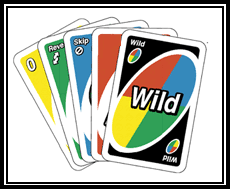
-Out of 23 UNO cards with 6 greens, 3 blues, 4 yellows, 5 reds, 2 blacks (a.k.a the wild card) 2 reverses and 1 skip card.


-You must pick a card out of 20 Uno cards.

-A green card costs you to go 5 steps ahead.

-A blue card costs 8 steps.


-A yellow card cost 7 steps.

-The red card costs 6 steps.

- Finally if you pick the black card you will
go back once only.

-
Reverse means you will now play counter clockwise which means you will have to skip and will not help because they might get ahead of you. In other hand, if you pick up the skip card. This means that you will play twice.

-This game is FAIR and FUN because the less cards there are in each color the more steps you make. The more cards there are in a colour the less steps you can get.

- There is only 2 black cards that might cost you to lose. This will be fun because it will get exciting at the end because there are more traps or black squares to reach.

Are You ready?

***Note: This can be played with a spinner. You can play it by spinning the spinner then whatever
colour it stops at, you will have to play them by the rules above with the colours red, green, blue and yellow (not w/ the black, reverse or skip cards.) So there will only be 18 cards and 4 different colours.

LET'S PLAY...


Questions: What is the probability of picking the green card?

ANSWER: P(green card)= P.O. / T.P.O

.... P.O
P ____ =
... T.P.O

6
__
= 0.26 x 100 = 26%

23

So the probability of getting a green card is 26%


Tuesday, October 24, 2006

E-49 #1-6


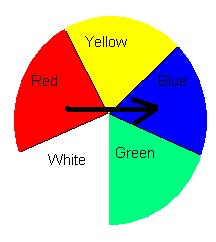
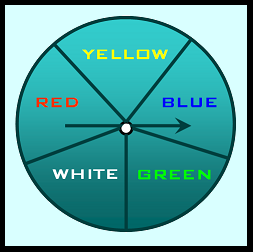
I.Find each probability if you spin the spinner once.
01.P(red) 1/5--20%
02.P(green) 1/5--20%
03.P(blue or white) 2/5--40%
04.P(not yellow) 4/5--80%
05.P(not red) 4/5--80%
06.P(blue red or yellow) 3/5--60%

Sunday, October 22, 2006

Math Homework . Page E-50 . # 1.

1 . Suppose you roll a regular 6-faced die .


( A ) How many equally likely outcomes are there ?


There are 6 equally likely outcomes . Because theres one of each number . 6 being the highest and 1 being the lowest .


( E ) If you roll the die once, what is the probability of rolling a 3 ?


The probability of rolling a 3 would be . P(3) = 1/6 . = 16.6%


( H ) If you roll the die 60 times, about how many times would you expect to get a 1 ?


You would get a 1 . About 10 times .


( I ) If you roll the die 300 times , about how many times would you expect to get a five .


You would get a 5 . About 50 times .


Friday, October 20, 2006

Q-E50 1,3


Question 1:
A: How many equally likely outcomes are there?
answer there are 6 outcomes on the dice so the highest number that you can get is six and the lowest is 1


H: if you roll a dice 60 times about how many times would you expect to get a 1

Answer: if you roll the dice 60 times you will only get the number 1 10 times

Question E 50 # 1 -2


For question 1 on e-49 it says how many equally likely outcomes are there ? so there is 6 outcomes how i got this anwser is a dice highest number is a six and if you conut on a dice there is only 6 numbers so thats i how i got 6 outcomes.

For question two on E-50 its says if you roll the dice once what is the probability of rolling a 3.
well there is only 1 three on a dice and if you roll once u can only can a fraction of 1 of 6 cause the 6 repersents how many numbers on the dice and 1 repersents u can only have 1 chance of getting a three on the dice

Thursday, October 19, 2006

{E-50 question #2 }

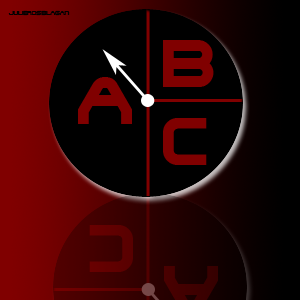
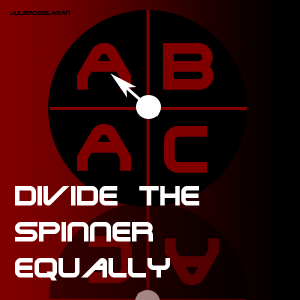
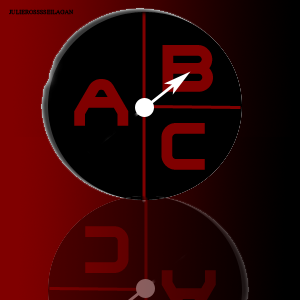
#2. A spinner is shown at the right for which each outcome is not equally likely.

E.) if you spin the spinner once, what is the probability that it will stop on A?

Answer: if you spin the spinner once, the probability of it stopping on A is 2/4

FRACTION=2/4

PERCENT=50%

A.) If you spin the spinner once, what is the probability that it will stop on B?


Answer: if you spin the spinner once, the probability of it stopping on B is 1/4

FRACTION=1/4

PERCENT=25%
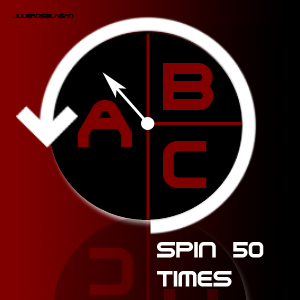
T.) If you spin the spinner 50 times, about how many times would you expect it to stop on A?

Answer: If you spin the spinner 50 times, the chances of it stopping on A every time is, 50%

Expressing as a fraction: 24/50 or 1/2

As a PERCENT : 50%
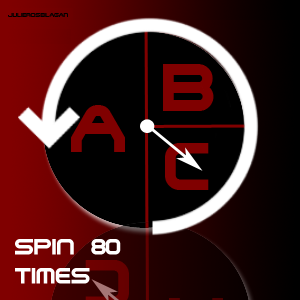
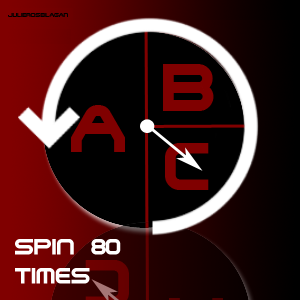
Y.) If you spin the spinner 80 times, about how many times would you expect it to stop on C?

Answer: If you spin the spinner 80 times, the chances of the spinner stopping on C every time is ,25%

Expressing as a fraction: 20/80 or 1/4

As a PERCENT: 25 %


HOW I GOT MY ANSWERS....

first of all, make the spinner even. so continue the line that divides b and c across so you won't get confused.
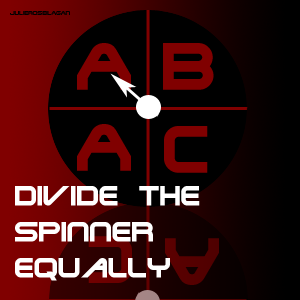
*E*
TO GET THE FRACTION

2/4 or 1/2

P.O (possible outcomes) OVER T.P.O. (total possible outcomes)

In this case the total possible outcomes would be 4. The possible outcome would be 2 because there are two A's in the spinner.You get 2/4 but you have to simplify it. So you get 1/2.

TO GET THE PERCENT....

1 divided by 2 or two divided by 4 = 0.5

you then, multiply 0.5 by 100 and it will give you 50. 50 is your percent. just add the % symbol at the end. 50%

*A*

To get the fraction....

you put the possible outcome which is 1 because there is only one B in the spinner, over the total possible outcome which is 4. You don't have to simplify this one.

1 = Possible Outcome

________________

4 = Total Possible Outcome

To get the Percent....

Divide 1 by 4 and you'll get 0.25.

multiply 0.25 by 100 and you'll get 25 %

*T*

To do this question, you would put the total possible outcome which is 50. because what were trying to figure out, is how many times will the spinner stop on a when we spin it 50 times?. You would have to have the original possible outcome and the total possible outcome which is 2/4.

Steps......

?/50 2/4

step one = divide the denominators. 50 divided by 4 = 12.5

step two = take 12.5 and multiply it by the original possible outcome. 2 x 12.5 = 25

then you get your other numerator which is 25 so. the answer would be, If you spin the spinner 50 times it would stop on letter a 25 times.

25/50

You also have to simplify it. so it would be 1/2 and you get that by diving the numerator by the denominator and multiplying it by 100.

*Y*

For this question you do the same thing with the last question. You put 80 as your total possible outcome and you take your original t.p.o and p.o and divide 80 by the original T.P.O. which is 4 and you get 20 multiply twenty by the original P.O. and you get 20

if you spin the spinner 80 times the arrow would stop at c 20 times.

20/80

simplify = 1/4

MY OWN QUESTION......

You're friend wants to give you some stickers. It's in a bag so you have to reach in and take some. In the bag, there are 15 spongebob stickers 50 mickey mouse stickers 5 cinderella stickers and 45 smiley faces stickers. What kind of sticker do you think you would have in your hand by the time you pull it out of the bag?

15 + 50 + 5 +45 = 115

your TPO would be 115

Spongebob : 15/115 11.5%

Mickey Mouse : 50/115 43.47%

Cinderella : 5/115 4.3 %

Smiley Faces : 45/115 39.13 %

By the time you pull your hand out of the bag you would have a Mickey Mouse sticker because it has the most.........

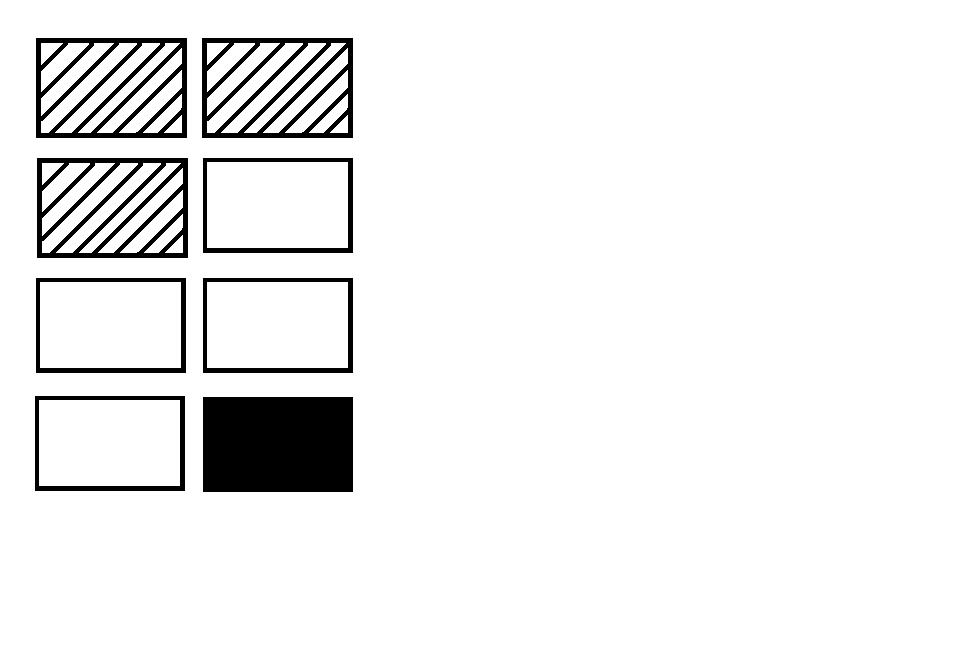
II. Find each probability if you choose one card at random.
7. P(striped)
Fraction: 3/8
Percentage: 37.5%
8.P(white)
Fraction:4/8=1/2
Percentage: 50%
9.P(shaded)
Fraction: 1/8
Percentage: 12.5
10.P(white or shaded)
Fraction:5/8
Percentage: 62.5
11.P(striped or white or shaded)
Fraction: 7/8
Percentage: 87.5
12.P(striped or shaded)
Fraction: 4/8=1/2
Percentage: 50%
13.P(not striped)
Fraction: 5/8
Percentage: 62.5%
14.P(not white)
Fraction: 4/8=1/2
Percentage: 50%
15.P(striped or white or shaded)
Fraction: 8/8=1
Percentage: 100%
My Question
I was playing a game of tag with 4 of my friends Bob,Bruce,Billy, and Joe. We couldn't decide who would be it so we all would yell "not it" on the coun't of three, and whoever is the last person to yell it would have to be it. What is the probability that Bruce would be it?
Answere
P Bruce
TPO All of the friends =1/5
Percentage: 1/5=0.2 x 100= 20%
*Mackenzie*

E49 Qustion I 1-6


TPO:5

1 P(Red) 1/5

2 P(Green) 1/5

3 P (Blue or White) 2/5

4 P (Not Yellow) 4/5

5 P (Not Red) 4/5

6 P (Blue or Red or Yellow) 3/5

New Question

P (Black) 0/5


Candy's E-49 19-21

Question 19
What is the probability of winning a raffle if 500 tickets are sold and you buy 5 of them?
P (win)
PO/TPO
5 /TPO
5/500
1/100
0.01 in 100
1%

Question 20
A class of 25 students has 15 girls and10 boys. If one student is chosen at random, what is the probability it is a girl?
P (girl)
PO/TPO
15/TPO
15/25
3/5
o.6 in 100
60%

Question 21
There are 26 letters in the alphabet. What is the probability that a letter chosen at random is in the word MATHEMATICS?
P (MATHEMATICS)
PO/TPO
8/TPO
8/26
4/13
0.307 in 100
30.7%

My own question

You go to the pound and you see 20 dogs they are all huskies. 5 of them are white with red on the back, 4 of them are white with black on the back, 8 of them are white with grey on the back, and 3 of them are white with red, black and grey on the back. What is the chance of the ones that are white with red on the back getting chosen?


Answer :
P (huskies)
PO/TPO
5/TPO
5/20
1/4
25 in 100
25%

E-49 (questions 1-6)

l. Find each probability if you spin the spinner once.


PO (Possible outcomes)

-----------

TPO (Total Possible Outcomes)

1) P (red)

As a fraction- 1/5

To get a percentage: 1 divided by 5= 0.2 x 100= 20%

2) P (green)

As a fraction- 1/5

Percentage: 20%

3) P (blue or white)

As a fraction- 2/5

Percantage- 40%

4) P (not yellow)

As a fraction- 4/5

Percentage- 80%

5) P (not red)As a fraction- 4/5

Percentage- 80%

P (blue or red or yellow)

As a fraction- 3/5

Percentage- 60%

My own question:

You go to a party and there are 80 party favours in a bag. 5 are lasers, 10 are stuffed toys, 25 are kazoos, 20 are bags of candy and 20 are computer games. What is the probability of pulling out anything besides the kazoos?

The answer:

5 + 10 + 20 + 20= 55

As a fraction- 55/80

Percentage- 55 divided by 80= 0.6875

0.6875 * 100= 68.75%

Kendra's E-49 19-21

Question 19

What is the probability of winning a raffle if 500 tickets are sold and you buy 5 of them?

P(win)
P.O/T.P.O
5/T.P.O
5/500
1/100
0.01*100
1%


Question 20

A class of 25 students has 15 girls and10 boys. If one student is chosen at random, what is the probability it is a girl?

P(girl)
P.O/T.P.O
15/T.P.O
15/25
3/5
0.6*100
60%


Question 21

There are 26 letters in the alphabet. What is the probability that a letter chosen at random is in the word MATHEMATICS?

P(mathematics)
P.O/T.P.O
8/T.P.O
8/26
4/13
0.307*100
30.7%

HINT: Do not count letters that are repeated in the word mathematics. If you do that,the answer would be 11/26 0.423 42.3%.

My own question

You go to a circus with 44 clowns. 12 don't talk and 32 talk. If a clown was chosen at random, what is the probability of a non-talking clown being chosen?

The answer

P.O/T.P.O
12/T.P.O
12/44
3/11
0.27*100
27%

Wednesday, October 18, 2006

E-50 [ question # 3 ] // charmaine's.

E-50 Question # 3:
Find each probability if you choose one marble at random.


P.O [ Possible Outcomes ]
----------------------------------
T.P.O [ Total Possible Outcomes ]

P (black)
black marble / t.p.o
3/10 = 0.3 = 30 %
divide 3 by 10, you'll get 0.3 then multiply by 100 to get 30 %


P (not black)
not black marble / t.p.o
7/10 = 0.7 = 70 %
divide 7 by 10 and you'll get 0.7, multiply it by 100 to get 70 %

P (black or white)
3 black or 1 white / t.p.o
4/10 = 2/5 = 0.4 = 40 %
simplify 4/10 to 2/5. divide 2 by 5 to get 0.4 then multiply it by 100 to get 40 %

P (striped)
striped marble / t.p.o
6/10 = 3/5 = 0.6 = 60 %
simplify 6/10 to 3/5. divide 3 by 5 to get 0.6 then multiply it by 100 to get 60 %

P (not white)
not white marble / t.p.o
9/10 = 0.9 = 90 %
divide 9 by 10 to get 0.9 then multiply by 100, and you'll get 90 %

P (yellow)
0, because there is no yellow marble.

--------
To answer those questions, find the possible outcomes and the total possible outcomes. Now, divide P.O by T.P.O and to get the answer, multiply it by 100 to get the percentage.
----------
My Own Question:
There are 15 dress, 19 shirts, 3 hats and 8 pants left in the store. What is the probability of shirts and hats ?


ANSWER:
15 + 19 + 3 + 8 = 45 ( total possible outcomes )
22 / 45
First add all the possible outcomes to get the total possible outcomes. Divide 22 by 45 to get the answer, then multiply it by 100 to get the percentage which is 48.8%


Levinia! (E-49 Q's 1-6)


P.O.(Possible Outcome)
_____________________________
T.P.O. (Total Possible Outcome)


PROCEDURE (percent):

1- divide the possible outcome by the total possible outcome (it's just like dividing the numerator by the denominator in fraction)
2- multiply by 100

for example:

1/2
1 is the possible outcome
2 is the total possible outcome
1/2= 0.5
0.5x100 is equal to 50% percent
another way or a shortcut of getting the percentage is by moving the decimal 2 places to the right

1.)
P
(red)

1/5= 0.2x100
Red / T.P.O. = 20%

2.)
P
(green)
1/5= 0.2x100
Green / T.P.O. = 20%

3.)
P
(blue or white)
2/5= 0.4x100
Blue & White / T.P.O. = 40%

4.)
P
(not yellow)
4/5= 0.8x100
Not Yellow / T.P.O. = 80%

5.)
P
(not red)
4/5= 0.8x100
Not Red / T.P.O. = 80%

6.)
P
(blue or red or yellow)
3/5= 0.6x100
Blue, Red, Yellow / T.P.O.= 60%


MY QUESTION: What is the probability of getting white or yellow?

ANSWER:
P 2/5= 0.4x100 White or Yellow/T.P.O. = 40%
- there is 40% chance of getting white or yellow if you spin once.


Question 3 A-M

3.E- 3/10 or 30% To get this answer , you must first find out the T.P.O.(Total Possible Outcomes). In this case ther are 10. In the diagram there are 3 Favorable outcomes. 3Black, 1White, and 6Striped. Since there are only 3 blacks the fraction is 3/10. The percentage is 30%.
3.A-Refer to lines one and two if you cannot remember the T.P.O. There are 3 blacks out of ten so the answer is 8/10. Simplified to 4/5. The percentage is 80%.
3.R- Black and white add up to 4 so the answer is 4/10. Simplified to 2/5. The percentage is 40%.
3.S-7 striped out of ten. 7/10. 70%.
3.E2-Not white equal to 9 /10. 90%
3.M-Ther are no yellow so the answer is 0/10. 0%.

Now if there happened to be fifteen marbles and the favourable outcomes were 8 striped, 5 black, and 2 whites, what would be the answer to number one? Two? Three?
Black would now be 5/15 or 1/3 with a percentage of 33.3%
Not black would be 10/15 or 2/3 or 66.6%
Black or White would now be 7/15 or 46.6%

Page E-50 question #3 and Michelle and Meldee's Board Game

Question #3 Find each probability if you choose 1 marble at random.

PO (possible outcomes)
__


TPO (total possible outcomes)


10 is the total number of marbles(TPO).

P black marble is: 3(black marbles)/10
3 divided by 10=0.3 then multiplied by 100= 30%

P striped marble is: 6(striped marbles)/10 0r 3/5
6 divided by 10=0.6 then multiplied by 100=60%

P not black is: 7(marbles not black)/10
7 divided by 10=0.7 then multiplied by 100=70%

P not white is:9(marbles not white)/10
9 divided by 10=0.9 then multiplied by 100=90%

P black or white marble is:4(black or white marbles)/10 or 2/5
3 black+1 white=4
4 divided by 10=0.4 then multiplied by 100=40%

P yellow is: 0
In the 10 marbles there are no yellow ones .

To answer these questions you have to know the PO(possible outcomes) and the TPO(total possible outcomes). To get the percentage, divide the numerator by the denominator. Then multiply the answer by 100.

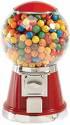
My question:In a gumball machine there were 26 blue, 14 red, 5 black and 9 purple.
What would be the probability that you would get a blue or purple gum ball?

Answer:P blue or purple is: 35(blue or purple gum balls)/54(gum balls)
35 divided by 54=0.648 then multiplied by 100=64.8


____________________________________________________
ROLL the DICE!


To play this game, you need a partner, 2 six sided dice and 1 colored bear for each person.
Who ever reaches the end of the path first, wins the game.

How to play:
Each person takes turns rolling the dice. If the dice sum of the 2 dice equals 4, 10, 6 or 8, you move 3 spaces forward. If the sum of the dice equals 3, 9, 5 or 11, you move 3 spaces backward. If the sum equals 7, you move 4 spaces forward. If the sum of the dice equals either 2 or 12, you move 5 spaces forward. This is because the probability of rolling a 2 or 12 is the lowest.


P( 3,9,5 or 11) = 2+2+4+4/36 = 12/36 = 2/3=66.6%

P(4,10,6,or 8) = 3+3+5+5/36 = 16/36 = 4/9 = 44.4%

P(7) = 6/36 = 1/6 = 16.6

P(2 or 12) = 2/36 = 1/24 =4.1%

This game is fair because each person has the same amount of turns rolling the dice. It's also fair because if you roll a number with a low probability, you move forward. If you roll a number with a high probability, you move backwards. It's fun because there are 2 numbers(2 and 12) that can make you be ahead of the other person.

Ready to play?


Tuesday, September 26, 2006

Question #5

Question 5
A) 33, 18, 40, 26, 29, 20, 30
18+20+26+29+30+33+40= 28
7
Mean 28, Median 29, Mode no mode, Range 22.
B) 20, 50, 20, 50, 17, 15, 25, 50, 25, 15
15+15+17+20+20+25+25+50+50+50= 28.7
10
Mean 28.7, Median 22.5, Mode 50, Range 35.
C) 15, 20, 80, 75, 5, 50
5+15+20+50+75+80= 40.8
6
Mean 40.8, Median 35, Mode no mode, Range75.
D)
16, 40, 44, 16, 40, 40, 80, 17, 64, 64, 100
16+16+17+40+40+40+44+64+64+80+100= 47.4
11
Mean 47.4, Median 40, Mode 40, Range 84.


I got the answer by adding the sum of all data. Then I divided how much information. Then you get the answer. Which is the MEAN, the MODE is the number that shows up the most, the MEDIAN is the number in the middle, and the RANGE is the first (smallest) number subtracted from the last (biggest) number.


Monday, September 25, 2006

Bill's History Marks!

2. Bill's history marks are: 72, 66, 65, 73, 71, 69, 68, 72.
Find the mean, mode, median and range.
Mean:
65+66+68+69+71+72+72+73= 556/8= 69.5

Mode- 72
Median- 65, 66, 68, 69, 71, 72, 72, 73= 69+71= 140/2= 70
Range- 73-65= 8


A) If he scores 91 on the next test, which measure of central tendency will be most affected? Explain.
Mean:
65+66+68+69+71+72+72+73+91= 647/9 = 71.8
or
556+91= 71.8

Mode- 72
Median- 65, 66, 68, 69, 71, 72, 72, 73, 91= 71 is the median
Range- 91-65= 26

The most affected measure of central tendency will be the range because it got higher by 18.


B) If he scores 66 on the next test, Which measure of central tendency will be most affected? Explain.
Mean:
65, 66, 66, 68, 69, 71, 72, 72, 73= 622/9= 69.1

Mode- 66 , 72
Median- 65, 66, 66, 68, 69, 71, 72, 72, 73= 69 is the median
Range- 73-65= 8

The most affected measure of central tendency will be the mode because there are more than one mode- 66 and 72.


Please feel free to comment on this post for any errors or suggestions.