Question 19
What is the probability of winning a raffle if 500 tickets are sold and you buy 5 of them?
P(win)
P.O/T.P.O
5/T.P.O
5/500
1/100
0.01*100
1%
Question 20
A class of 25 students has 15 girls and10 boys. If one student is chosen at random, what is the probability it is a girl?
P(girl)
P.O/T.P.O
15/T.P.O
15/25
3/5
0.6*100
60%
Question 21
There are 26 letters in the alphabet. What is the probability that a letter chosen at random is in the word MATHEMATICS?
P(mathematics)
P.O/T.P.O
8/T.P.O
8/26
4/13
0.307*100
30.7%
HINT: Do not count letters that are repeated in the word mathematics. If you do that,the answer would be 11/26 0.423 42.3%.
My own question
You go to a circus with 44 clowns. 12 don't talk and 32 talk. If a clown was chosen at random, what is the probability of a non-talking clown being chosen?
The answer
P.O/T.P.O
12/T.P.O
12/44
3/11
0.27*100
27%
Thursday, October 19, 2006

Wednesday, October 18, 2006
E-50 [ question # 3 ] // charmaine's.
E-50 Question # 3:
Find each probability if you choose one marble at random.

P.O [ Possible Outcomes ]
----------------------------------
T.P.O [ Total Possible Outcomes ]
P (black)
black marble / t.p.o
3/10 = 0.3 = 30 %
divide 3 by 10, you'll get 0.3 then multiply by 100 to get 30 %
P (not black)
not black marble / t.p.o
7/10 = 0.7 = 70 %
divide 7 by 10 and you'll get 0.7, multiply it by 100 to get 70 %
P (black or white)
3 black or 1 white / t.p.o
4/10 = 2/5 = 0.4 = 40 %
simplify 4/10 to 2/5. divide 2 by 5 to get 0.4 then multiply it by 100 to get 40 %
P (striped)
striped marble / t.p.o
6/10 = 3/5 = 0.6 = 60 %
simplify 6/10 to 3/5. divide 3 by 5 to get 0.6 then multiply it by 100 to get 60 %
P (not white)
not white marble / t.p.o
9/10 = 0.9 = 90 %
divide 9 by 10 to get 0.9 then multiply by 100, and you'll get 90 %
P (yellow)
0, because there is no yellow marble.
--------
To answer those questions, find the possible outcomes and the total possible outcomes. Now, divide P.O by T.P.O and to get the answer, multiply it by 100 to get the percentage.
----------
My Own Question:
There are 15 dress, 19 shirts, 3 hats and 8 pants left in the store. What is the probability of shirts and hats ?
ANSWER:
15 + 19 + 3 + 8 = 45 ( total possible outcomes )
22 / 45
First add all the possible outcomes to get the total possible outcomes. Divide 22 by 45 to get the answer, then multiply it by 100 to get the percentage which is 48.8%
Find each probability if you choose one marble at random.

P.O [ Possible Outcomes ]
----------------------------------
T.P.O [ Total Possible Outcomes ]
P (black)
black marble / t.p.o
3/10 = 0.3 = 30 %
divide 3 by 10, you'll get 0.3 then multiply by 100 to get 30 %
P (not black)
not black marble / t.p.o
7/10 = 0.7 = 70 %
divide 7 by 10 and you'll get 0.7, multiply it by 100 to get 70 %
P (black or white)
3 black or 1 white / t.p.o
4/10 = 2/5 = 0.4 = 40 %
simplify 4/10 to 2/5. divide 2 by 5 to get 0.4 then multiply it by 100 to get 40 %
P (striped)
striped marble / t.p.o
6/10 = 3/5 = 0.6 = 60 %
simplify 6/10 to 3/5. divide 3 by 5 to get 0.6 then multiply it by 100 to get 60 %
P (not white)
not white marble / t.p.o
9/10 = 0.9 = 90 %
divide 9 by 10 to get 0.9 then multiply by 100, and you'll get 90 %
P (yellow)
0, because there is no yellow marble.
--------
To answer those questions, find the possible outcomes and the total possible outcomes. Now, divide P.O by T.P.O and to get the answer, multiply it by 100 to get the percentage.
----------
My Own Question:
There are 15 dress, 19 shirts, 3 hats and 8 pants left in the store. What is the probability of shirts and hats ?
ANSWER:
15 + 19 + 3 + 8 = 45 ( total possible outcomes )
22 / 45
First add all the possible outcomes to get the total possible outcomes. Divide 22 by 45 to get the answer, then multiply it by 100 to get the percentage which is 48.8%
Levinia! (E-49 Q's 1-6)

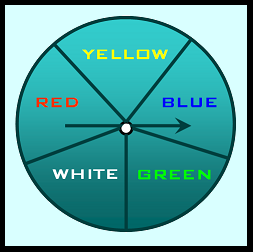
P.O.(Possible Outcome)
_____________________________
T.P.O. (Total Possible Outcome)
T.P.O. (Total Possible Outcome)
PROCEDURE (percent):
1- divide the possible outcome by the total possible outcome (it's just like dividing the numerator by the denominator in fraction)
2- multiply by 100
for example:
1/2
1 is the possible outcome
2 is the total possible outcome
1/2= 0.5
0.5x100 is equal to 50% percent
another way or a shortcut of getting the percentage is by moving the decimal 2 places to the right
1.)
P (red)
1/5= 0.2x100
Red / T.P.O. = 20%
2.)
P (green)
1/5= 0.2x100
Green / T.P.O. = 20%
3.)
P (blue or white)
2/5= 0.4x100
Blue & White / T.P.O. = 40%
4.)
P (not yellow)
4/5= 0.8x100
Not Yellow / T.P.O. = 80%
5.)
P (not red)
4/5= 0.8x100
Not Red / T.P.O. = 80%
6.)
P(blue or red or yellow)
3/5= 0.6x100
Blue, Red, Yellow / T.P.O.= 60%
P (red)
1/5= 0.2x100
Red / T.P.O. = 20%
2.)
P (green)
1/5= 0.2x100
Green / T.P.O. = 20%
3.)
P (blue or white)
2/5= 0.4x100
Blue & White / T.P.O. = 40%
4.)
P (not yellow)
4/5= 0.8x100
Not Yellow / T.P.O. = 80%
5.)
P (not red)
4/5= 0.8x100
Not Red / T.P.O. = 80%
6.)
P(blue or red or yellow)
3/5= 0.6x100
Blue, Red, Yellow / T.P.O.= 60%
MY QUESTION: What is the probability of getting white or yellow?
ANSWER: P 2/5= 0.4x100 White or Yellow/T.P.O. = 40%
- there is 40% chance of getting white or yellow if you spin once.
ANSWER: P 2/5= 0.4x100 White or Yellow/T.P.O. = 40%
- there is 40% chance of getting white or yellow if you spin once.
Question 3 A-M
3.E- 3/10 or 30% To get this answer , you must first find out the T.P.O.(Total Possible Outcomes). In this case ther are 10. In the diagram there are 3 Favorable outcomes. 3Black, 1White, and 6Striped. Since there are only 3 blacks the fraction is 3/10. The percentage is 30%.
3.A-Refer to lines one and two if you cannot remember the T.P.O. There are 3 blacks out of ten so the answer is 8/10. Simplified to 4/5. The percentage is 80%.
3.R- Black and white add up to 4 so the answer is 4/10. Simplified to 2/5. The percentage is 40%.
3.S-7 striped out of ten. 7/10. 70%.
3.E2-Not white equal to 9 /10. 90%
3.M-Ther are no yellow so the answer is 0/10. 0%.
Now if there happened to be fifteen marbles and the favourable outcomes were 8 striped, 5 black, and 2 whites, what would be the answer to number one? Two? Three?
Black would now be 5/15 or 1/3 with a percentage of 33.3%
Not black would be 10/15 or 2/3 or 66.6%
Black or White would now be 7/15 or 46.6%
3.A-Refer to lines one and two if you cannot remember the T.P.O. There are 3 blacks out of ten so the answer is 8/10. Simplified to 4/5. The percentage is 80%.
3.R- Black and white add up to 4 so the answer is 4/10. Simplified to 2/5. The percentage is 40%.
3.S-7 striped out of ten. 7/10. 70%.
3.E2-Not white equal to 9 /10. 90%
3.M-Ther are no yellow so the answer is 0/10. 0%.
Now if there happened to be fifteen marbles and the favourable outcomes were 8 striped, 5 black, and 2 whites, what would be the answer to number one? Two? Three?
Black would now be 5/15 or 1/3 with a percentage of 33.3%
Not black would be 10/15 or 2/3 or 66.6%
Black or White would now be 7/15 or 46.6%
Page E-50 question #3 and Michelle and Meldee's Board Game
Question #3 Find each probability if you choose 1 marble at random.
PO (possible outcomes)
__
TPO (total possible outcomes)

10 is the total number of marbles(TPO).
P black marble is: 3(black marbles)/10
3 divided by 10=0.3 then multiplied by 100= 30%
P striped marble is: 6(striped marbles)/10 0r 3/5
6 divided by 10=0.6 then multiplied by 100=60%
P not black is: 7(marbles not black)/10
7 divided by 10=0.7 then multiplied by 100=70%
P not white is:9(marbles not white)/10
9 divided by 10=0.9 then multiplied by 100=90%
P black or white marble is:4(black or white marbles)/10 or 2/5
3 black+1 white=4
4 divided by 10=0.4 then multiplied by 100=40%
P yellow is: 0
In the 10 marbles there are no yellow ones .
To answer these questions you have to know the PO(possible outcomes) and the TPO(total possible outcomes). To get the percentage, divide the numerator by the denominator. Then multiply the answer by 100.
 My question:In a gumball machine there were 26 blue, 14 red, 5 black and 9 purple.
What would be the probability that you would get a blue or purple gum ball?
Answer:P blue or purple is: 35(blue or purple gum balls)/54(gum balls)
35 divided by 54=0.648 then multiplied by 100=64.8
PO (possible outcomes)
__
TPO (total possible outcomes)

10 is the total number of marbles(TPO).
P black marble is: 3(black marbles)/10
3 divided by 10=0.3 then multiplied by 100= 30%
P striped marble is: 6(striped marbles)/10 0r 3/5
6 divided by 10=0.6 then multiplied by 100=60%
P not black is: 7(marbles not black)/10
7 divided by 10=0.7 then multiplied by 100=70%
P not white is:9(marbles not white)/10
9 divided by 10=0.9 then multiplied by 100=90%
P black or white marble is:4(black or white marbles)/10 or 2/5
3 black+1 white=4
4 divided by 10=0.4 then multiplied by 100=40%
P yellow is: 0
In the 10 marbles there are no yellow ones .
To answer these questions you have to know the PO(possible outcomes) and the TPO(total possible outcomes). To get the percentage, divide the numerator by the denominator. Then multiply the answer by 100.
 My question:In a gumball machine there were 26 blue, 14 red, 5 black and 9 purple.
 What would be the probability that you would get a blue or purple gum ball?
Answer:P blue or purple is: 35(blue or purple gum balls)/54(gum balls)
35 divided by 54=0.648 then multiplied by 100=64.8
____________________________________________________
ROLL the DICE!
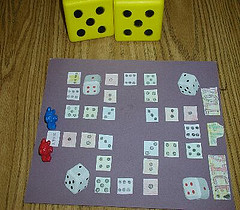

To play this game, you need a partner, 2 six sided dice and 1 colored bear for each person.
Who ever reaches the end of the path first, wins the game.
How to play:
Each person takes turns rolling the dice. If the dice sum of the 2 dice equals 4, 10, 6 or 8, you move 3 spaces forward. If the sum of the dice equals 3, 9, 5 or 11, you move 3 spaces backward. If the sum equals 7, you move 4 spaces forward. If the sum of the dice equals either 2 or 12, you move 5 spaces forward. This is because the probability of rolling a 2 or 12 is the lowest.
P( 3,9,5 or 11) = 2+2+4+4/36 = 12/36 = 2/3=66.6%
P(4,10,6,or 8) = 3+3+5+5/36 = 16/36 = 4/9 = 44.4%
P(7) = 6/36 = 1/6 = 16.6
P(2 or 12) = 2/36 = 1/24 =4.1%
This game is fair because each person has the same amount of turns rolling the dice. It's also fair because if you roll a number with a low probability, you move forward. If you roll a number with a high probability, you move backwards. It's fun because there are 2 numbers(2 and 12) that can make you be ahead of the other person.
Ready to play?
Thursday, October 05, 2006
Making a Personal Learning Network
I would like you to create a Personal Learning Network. This is a network of Blogs and other sites that have RSS feeds. You could start with the 5 blogs out of Sargent Park and branch off from there.
Here is a 7 minute screencast that shows you how to set up a Bloglines Account. After you watch it please start to make your own Personal Learning Network. This is the second attempt at making it loud enough. Can you hear me now:-)
Here is a 7 minute screencast that shows you how to set up a Bloglines Account. After you watch it please start to make your own Personal Learning Network. This is the second attempt at making it loud enough. Can you hear me now:-)
How to make a Personal Learning Network.
You need to create a Bloglines Account. Bloglines is a service that collects all the new posts from blogs that you subscribe too.
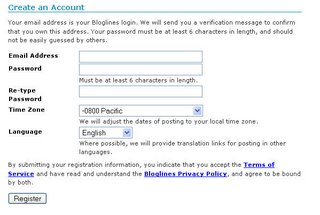
At this page please use your email address and a passwork youwill not forget. Change the time to 0600 central time. Now click register. This is the screen you should see.

In your email respond to the bloglines email by clicking on the link.
 I would suggest skipping the next page and clicking on
 Now for the good stuff!!
To start your Personal Learning Network I would like you to subscribe to the 4 math classes and the Sargent Park Math Hub. This will keep you up to date when other students create posts that you would like to view and comment on. Commenting on each others work is the most important aspect of blogging.
In the window
 paste the following url
You need to create a Bloglines Account. Bloglines is a service that collects all the new posts from blogs that you subscribe too.

At this page please use your email address and a passwork youwill not forget. Change the time to 0600 central time. Now click register. This is the screen you should see.

In your email respond to the bloglines email by clicking on the link.
 I would suggest skipping the next page and clicking on
 Now for the good stuff!!
To start your Personal Learning Network I would like you to subscribe to the 4 math classes and the Sargent Park Math Hub. This will keep you up to date when other students create posts that you would like to view and comment on. Commenting on each others work is the most important aspect of blogging.
In the window
 paste the following url
www.sargentparkmathzone.blogspot.com

Use the following feed to subscribe (click the box in the right corner).
 Choose new folder
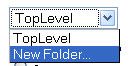 save as
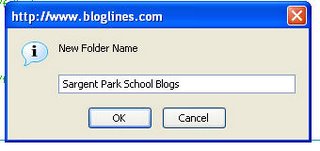 now click subscribe.

Use the following feed to subscribe (click the box in the right corner).
 Choose new folder
 save as
 now click subscribe.
You now have a new screen. This is your dashboard for Bloglines. To add the remaining blogs
816math.blogspot.com
817math.blogspot.com
841math.blogspot.com
873math.blogspot.com
817math.blogspot.com
841math.blogspot.com
873math.blogspot.com
follow the following proceedure.
Click add in the upper left hand corner.

Paste the address in the subscribe box then make sure you put this new blog in the following folder
 Click subscribe and do the rest of the class sites.
These 5 blogs will be the start to your Personal Learning network. Next stop other sites that will help with your personal learning.
But that is another post!!!
Click add in the upper left hand corner.

Paste the address in the subscribe box then make sure you put this new blog in the following folder
 Click subscribe and do the rest of the class sites.
These 5 blogs will be the start to your Personal Learning network. Next stop other sites that will help with your personal learning.
But that is another post!!!
Sunday, October 01, 2006
Why we learn Math
As I was cruising the net looking for something interesting to say I found this movie at Google Movies. The Math Lesson
is the reason why we learn math and need to understand the concepts behind the arithmatic.
Enjoy the show!!
Leave a comment about what you think about this video clip.
Mr. Harbeck
is the reason why we learn math and need to understand the concepts behind the arithmatic.
Enjoy the show!!
Leave a comment about what you think about this video clip.
Mr. Harbeck
Subscribe to:
Posts (Atom)

